Resources are finite and sustainable living is one of the best ways that individuals can help slow Climate Change in its tracks. On this page we will explore the ways in which you can live a more sustainable lifestyle, including information on local groups that help facilitate this.


Sustainability
Short-Sightedness and Overconsumption
Humans have been using Earth’s natural resources in an unsustainable way since the industrial revolution, with overuse only continuing to accelerate today. Manufacturing uses a large amount of natural resources such as metals and minerals to create products from smartphones to cars. The extraction and production of these materials, such as steel, sometimes incorporates chemical processes that release greenhouse gases into the atmosphere. As well as industrial uses many agricultural practices are not thinking of the long-term, often over farming land for a quick profit to the detriment of the environment. Clearing of land for farming and the overuse of pesticides and chemical fertilizers has a detrimental effect to an area’s wildlife and biodiversity.
We as consumers are also contributing to the problem, as the “make do and mend” mindset has fallen out of favour. Nowadays people are far more likely to replace something rather than repair it, meaning that our consumption of goods has skyrocketed. In fact, if everyone lived like the average American citizen then we would need 4.1 Earths to sustain the consumption of resources. Part of this is not the fault of the consumer, as “planned obsolescence” by manufacturers has made it harder than ever to actually repair items and means that most of the time it is actually cheaper to replace them altogether.
How Can We Live More Sustainably?
Living within your means is not just good financial advice, it is also reflective of how we should aim to live a more sustainable lifestyle. Reducing, reusing, and recycling is not just a fun bit of alliteration, it is the core ethos of sustainable living.
The choices we make every day of our lives have implications for both our local environment and the whole world. As individuals, one of the best ways to help our planet is to change our habits and make more informed choices.
Changing Habits – Shopping
A chore for some, a joy for many, shopping is part of the modern human experience that is inescapable. The way that we shop has a direct impact on the environment through means of production, shipping, waste, and overconsumption.
Modern consumerism got its start in the post World War II era where rationing had ended and new sources of media were a perfect vehicle to tell the public to “buy this!”, “buy more!”, “buy now!”. As the economy became stronger and the middle class grew, there was more emphasis on purchasing non-essential items that has previously only been marketed to the upper classes. Companies were no longer just selling quality products, they were selling status.
In 1955 retail analyst Victor Lebow said, “Our enormously productive economy demands that we make consumption our way of life, that we convert the buying and use of goods into rituals, that we seek our spiritual satisfaction, our ego satisfaction, in consumption.… We need things consumed, burned up, replaced and discarded at an ever-accelerating rate.”
This constant “need” to buy things was reinforced by advertising campaigns and products that were intentionally designed to be inferior (planned obsolescence). In the past few decades this habit of consistently purchasing things, things we don’t even need, has spiralled out of control and has left generations struggling to break free from the cycle of consumerism.
So, back to the question at hand, how can we change our habits to reduce the impact we have on the environment?

Think Twice
It seems like an obvious place to start, but sometimes one of the easiest ways to reduce your overall consumption is just to give your purchases a second thought. We can all fall victim to a spur of the moment “oh, but I must have it” impulse purchase, but taking time to evaluate what you really need when out shopping will help you buy less unnecessary items and in turn save your money for more important things.
Second Hand Goodies
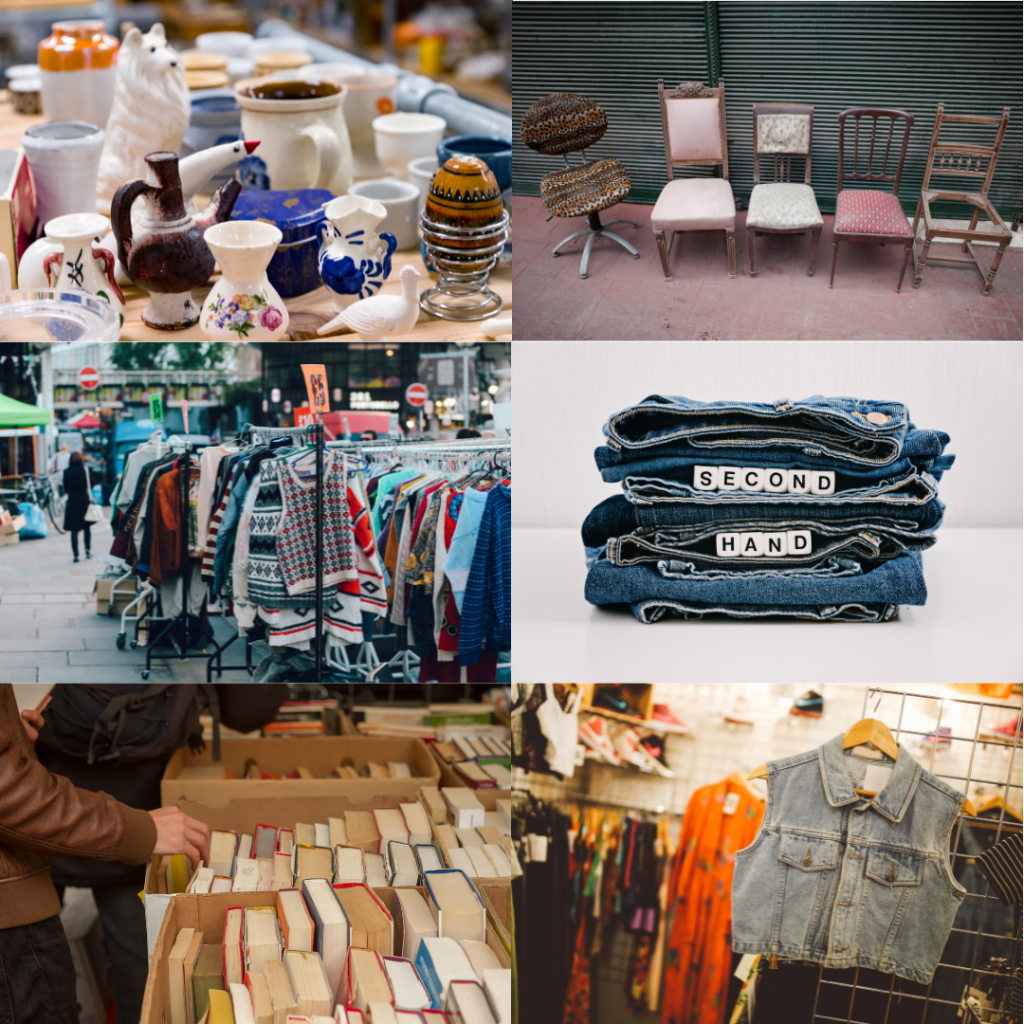
Buying second hand is a fantastic way to reduce your carbon footprint when it comes to shopping. Clothes are especially easy to come by in second hand spaces but you can also find excellent gifts, furniture, entertainment, and decor.
When thinking of buying second hand the first thing that comes to mind is a local charity shop. These shops can be real treasure troves and you know when going in that the dedicated staff and volunteers have already sifted through donations to make sure that only good-quality items go out on the shop floor. When shopping in a charity shop, you also know that any money you spend is going to a good cause.
If you’re looking to mix your sustainable shopping with a nice day out, car boot sales are another good place to source second hand items. You may need to take initiative and check item quality (e.g. make sure that clothes have no rips or missing buttons) and bring your best haggling game as you may be able to talk yourself into a real bargain.
For the more technologically advanced of you out there, there are many options online to help you on your journey to being a second hand superstar. To keep purchases local, try Facebook Marketplace or local buying and selling groups. If you want to cast your net a bit wider, you can use webpages such as eBay or use popular apps like Depop and Vinted. These sites do their best to weed out unreliable sellers but we still encourage your to do your due diligence and check seller reviews and and return or refund policies.
Consider Materials
The 21st Century is an age of plastics, this material is cheap, versatile, and can be used in infinite ways. Since the first synthetic plastic, Bakelite, was produced in 1907 our production and consumption of plastic goods has increased exponentially. This graph shows that even in the last 20 years that global plastics production has doubled.
You may be surprised to learn just how much plastic is used in the products you use every day. For example, polyester and nylon account for 69% of all the materials used in clothing today with this number expected to increase to 75% by 2030.
You may be surprised to learn just how much plastic is used in the products you use every day. For example, polyester and nylon account for 69% of all the materials used in clothing today with this number expected to increase to 75% by 2030. We use plastic in clothes for the same reason we use it everywhere else – it is inexpensive and not dependent on weather patterns or seasons to produce like natural materials are. Take a look at the clothing you are wearing right now and see how much of it is made of polyester, nylon, acrylic, or elastane.
Plastic is well-known to last for a long, long, long time. This is something that makes it so desirable but also so dangerous. When plastic breaks down it doesn’t rot like a natural material, it becomes microplastic – microscopic pieces of plastic that can enter water sources, soil, and even our own bodies. Scientists from Duke University found that the concentrations of microplastics in the human brain rose by a staggering 50% between 2016 and 2024. Microplastics have also been found in the tissues of the liver and kidneys and in 2020 the first evidence of microplastic in a human placenta was discovered. Though the health implications of microplastics within the human body are yet unknown, though early studies are showing links to inflammation, impaired immune systems, metabolic issues, and cell damage.
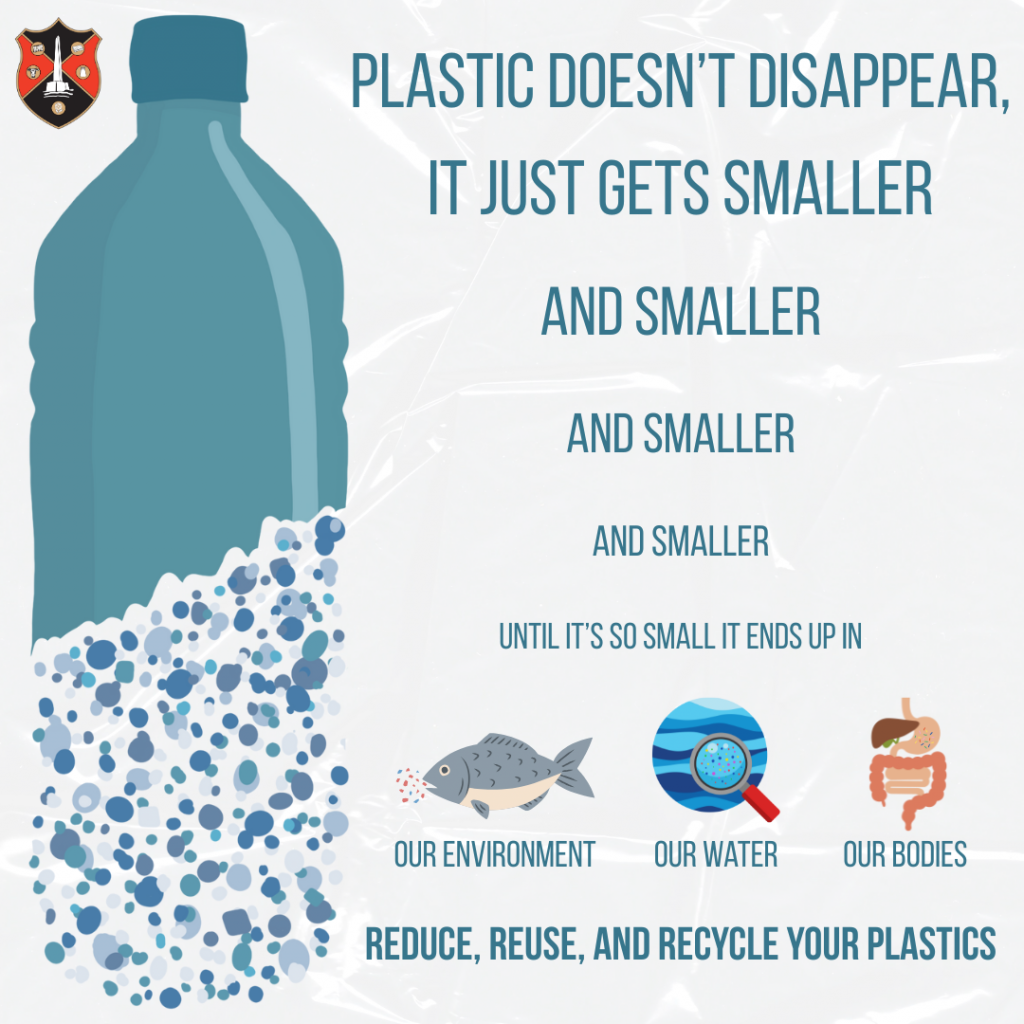
Microplastics enter our environment in a range of ways other than the previously mentioned breaking down of larger plastic items. Remember how much plastic is in our clothes? When these clothes are washed, fibres are shed and carried off with the wastewater. Tyres, paints, and coatings can wear away with time, spreading microscopic flakes of plastic throughout the environment via water or wind. Once these particles are in the soil and water, they find their way into our bodies through the food we eat and the water we drink. It is also possible for particles to be inhaled. The tiniest of microplastics, known as nanoplastics, are small enough to pass through the linings of our intestines or lungs, allowing them to enter our bloodstream and organs.
The old adage “buy nice or buy twice” comes to mind as we often find that items made from higher-quality materials and to a higher standard last significantly longer than cheap an cheerful versions of the same product. Terry Pratchett’s “Boots Theory” from Men At Arms describes how it can be costly to buy cheaply, as at any one time someone on a lower income may only be able to afford to spend a small amount of money on a pair of boots. These cheaper boots wear out quickly and before you know it you need another pair. Whereas if someone was able to spend more upfront on a pair of boots, they would last for years and years, therefore costing less in the long run.
Support Sustainable Businesses
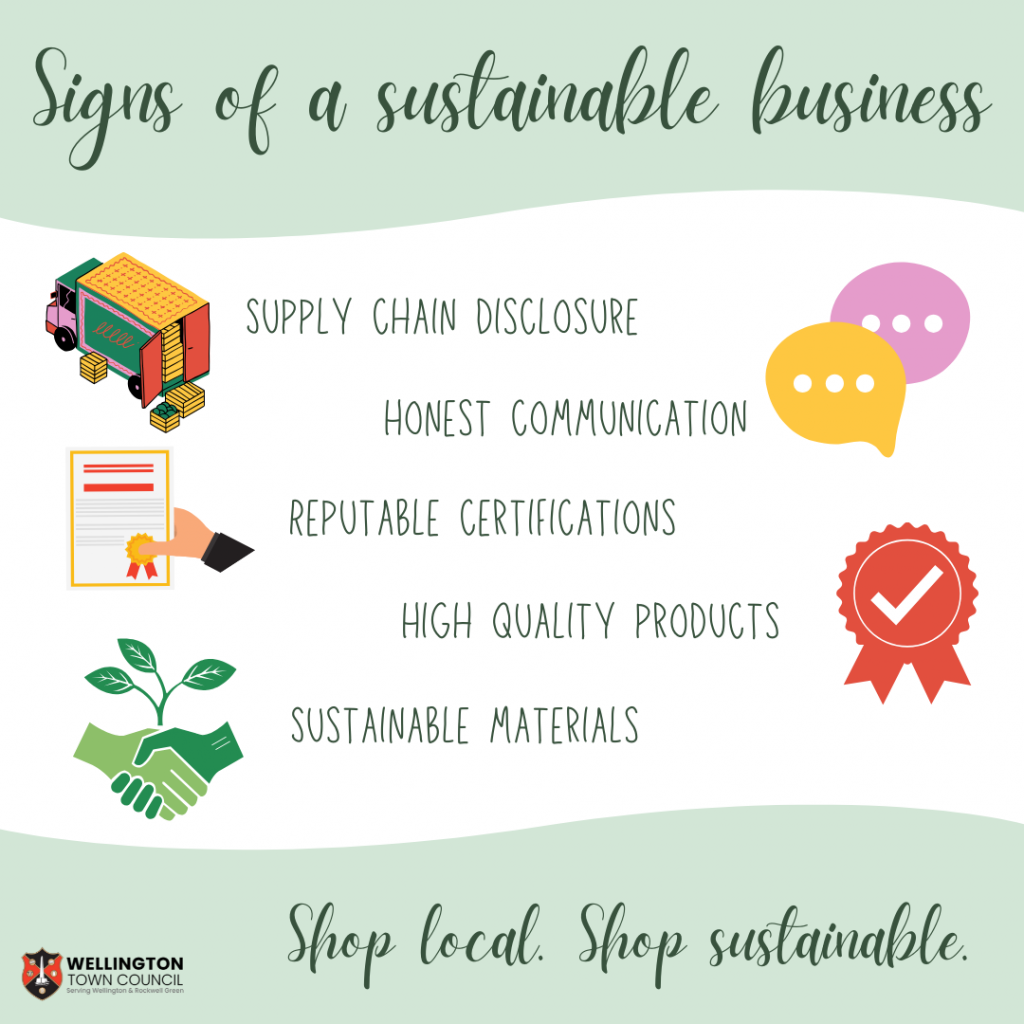
Not all businesses are created equal and it is unfortunately the case that many larger corporations value profits over sustainable production practices. Many retailers that deal in fast fashion and cheap household goods produce their wares in ways that harm the environment and often also have negative humanitarian implications.
When looking into whether a business can be considered sustainable, keep an eye out for their honesty and how clearly they disclose their supply chain. Businesses that run sustainably are proud to say so and will usually display evidence on their website or include copy in their product description.
If you are able to shop around and choose to support businesses that pride themselves on sustainable production and fair trade, you can be safe in the knowledge that you are doing your due diligence.
Changing Habits – Waste
The UK generates over 200 million tonnes of waste annually. Although over 44% of this is recycled, with up to 75% of packaging waste recycled, our numbers are far behind where they should be with countries such as The Netherlands, Germany, and Spain recycling well over half of household waste.
It is important for us to think more about what we do and do not throw away and to change our our overall mindsets on waste and recycling.
Repair and Repurpose
Being able to mend your own clothes is a skill that is becoming less common but we think it’s due for a comeback! Many simple repairs on clothing and in the home can be done yourself. Even if you haven’t done it before, the University of YouTube is always accepting new students! For example, if you need to hem a pair of trousers and have all the gear but no idea, get online and watch through a couple of how-to videos. Many of these videos offer step-by step instructions that can be followed along while you do the task. For more complex repairs, fixes that may be dangerous, or for when you would rather trust in someone else’s skills there are many services in the area to help you with your fixes and alterations. For example, there is a bi-monthly Repair Cafe run by Transition Town Wellington that has a team of repairers who are available to fix items of all sorts for a small donation to keep the initiative running.
Repurposing items can be a real chance to get creative and give something a new lease of life. You may already be repurposing without thinking about it – have you ever cut up an old ratty t-shirt to use the scraps as cleaning rags? Used takeaway containers as food storage? Or used an old jar as a vase? All of these are considered repurposing or re-using. If you’re looking to kick it up a notch you can find lots of ideas online ranging from simple DIYs to bigger projects that you will be proud to display in your home. A great place to start for inspirations is Pinterest.
Choose Reusable
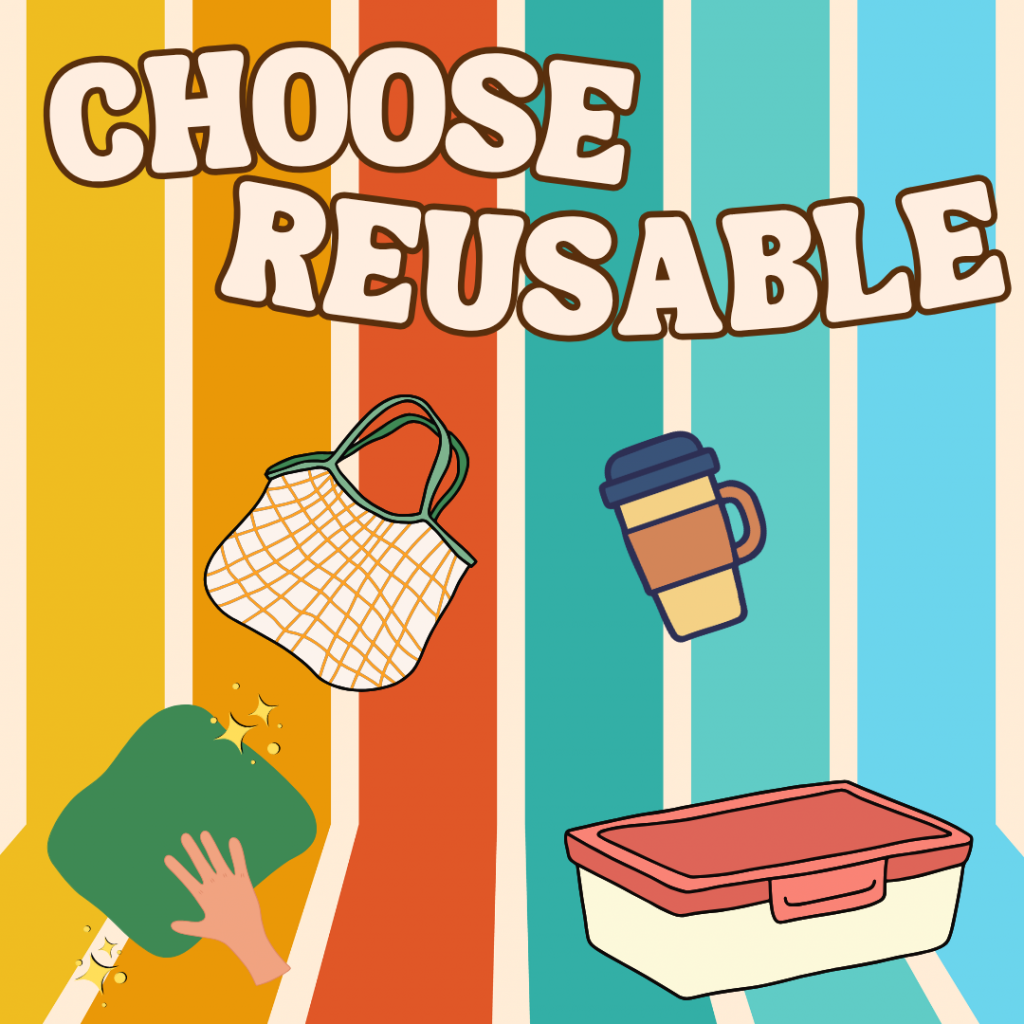
Single-use products have changed the way that we view the world and our place within it. The convenience that single-use products offer make them immensely useful within our society but also incredibly damaging to the environment as they are discarded and break down. There are of course instances where single-use products have improved our lives and remain necessary, for instance in the medical field, but in most cases for any single-use product there is a reusable alternative that is available.
Here are a few examples of ways you can bring more reusable into your life:
- Bring a reusable coffee cup with you
- Bring shopping bags with you
- Use cleaning cloths instead of paper towels
- Use steel or glass boxes for meal prep and leftovers
- Replace cling film with beeswax wraps
- Replace plastic food bags with washable silicone ones
All of the above and more can be done to reduce your reliance on single-use products.
Recycling is Key
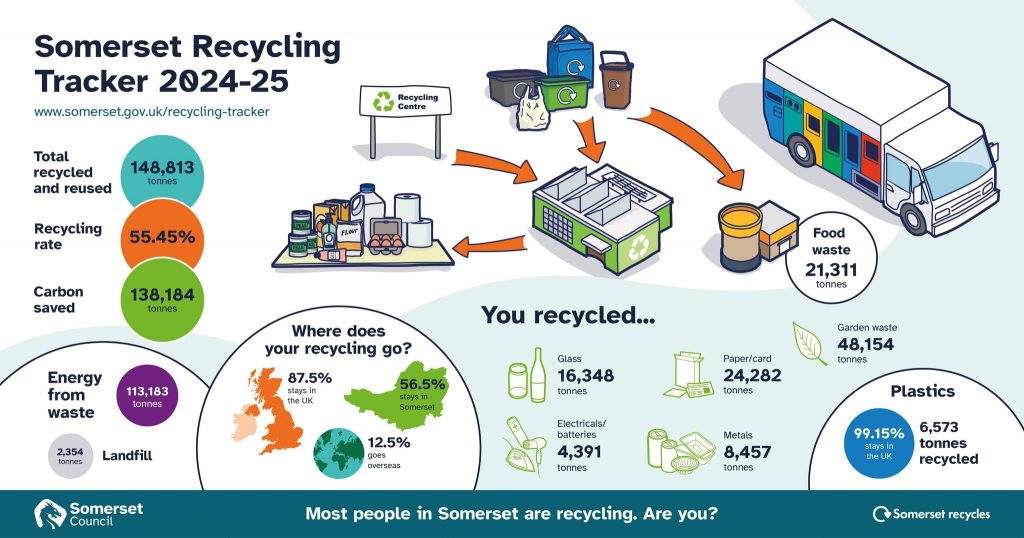
Between 2024 and 2025, the county of Somerset recycled over 55% of its waste, putting us above the average UK rate of around 44%. Kerbside recycling collection was introduced in the county in around 2003 with more and more materials being accepted. The reduction of refuse collections to once every three weeks was not a popular change but it has in turn forced residents to take up the recycling opportunities on offer, therefore increasing the overall percentage of waste recycled in Somerset.
We are also fortunate in Wellington particularly to have a free recycling centre right at the edge of town. This site allows local people to recycle almost anything and items that cannot be recycled are incinerated to produce energy. Some charges apply for commercial waste or the disposal of items such as asbestos and plaster. Please check their website for details.